


HART
The Highway Addressable Remote Transducer (HART) protocol provides digital communication to microprocessor-based analog process control instruments.
HART uses the Bell 202 frequency-shift-keying (FSK) standard to superimpose a digital signal on top of the 4-20mA current loop analog signal:
the analog signal communicates the primary measured process variable value
the digital signal communicates additional instrument information including instrument status, additional process variables, configuration data, and diagnostics
The digital signal shifts between a frequency of 1200 Hz (representing a binary 1) and a frequency of 2200 Hz (representing a binary 0):
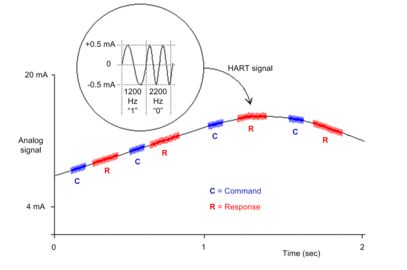
These digital signal frequencies are higher than the typical analog signaling frequency range of 0...10 Hz. The digital signal is typically isolated using a passive high-pass filter with a cut-off frequency in the range of 400...800 Hz. The analog signal is likewise isolated using a passive low-pass filter.
The separation in frequency between HART and analog signaling allows both signals to coexist on the same current loop. Because the HART digital signal is phase continuous, the HART digital signal:
does not interfere with the 4-20 mA signal, and
allows the analog process to continue operating during HART digital communication
Half-duplex Communication Protocol
HART communication is half-duplex in design, which means that a HART-compliant instrument does not simultaneously transmit and receive.
Primary — Secondary Protocol
HART is a primary-secondary protocol. A HART-secondary instrument responds only when commanded by a HART primary instrument. Examples of HART-compliant instruments include:
HART primary:
asset management software (AMS) running on a PC
a HART interface module, for example, the HART modem feature of both the BMEAHI0812(H) input module and the BMEAHO0412(C) output module when communicating with a HART process control instrument (such as a HART-compliant sensor or actuator)
a hand-held device temporarily attached to the network
HART secondary:
a HART process control instrument
a HART interface module, for example, the HART modem feature of both the BMEAHI0812(H) input module and the BMEAHO0412(C) output module when operating as a secondary instrument with asset management software (AMS) or a HART server