


Introduction
The BMEAHI0812(H) eX80 HART analog input module supports 4-20 mA analog communication and HART digital communication on each of 8 input channels. The module operates with voltage inputs and includes 8 read resistors connected to the terminal block to convert current inputs.
The eX80 HART analog input module is powered by the backplane.
Measurement Timing
The BMEAHI0812(H) eX80 HART analog input module measurement refresh rate is 4 ms. This refresh rate remains constant, no matter how many channels are enabled (or disabled).
Overflow/Underflow Control
Each input on the BMEAHI0812(H) eX80 HART analog input module operates over a range of 4-20 mA. You can map up to five current ranges for each input.
Upper and lower tolerance detections are enabled regardless of overflow/underflow control.
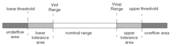
Depending on the range specified, the module checks for overflow and verifies that the measurement falls between a lower and an upper threshold:
Designation |
Description |
|---|---|
Nominal range |
The specified measurement range |
Upper tolerance area |
The range of values between the maximum value for the nominal range (20 mA) and the upper threshold |
Lower tolerance area |
The range of values between the minimum value for the nominal range (4 mA) and the lower threshold |
Overflow area |
The range of values located above the upper threshold |
Underflow area |
The range of values located below the lower threshold |
The values of the thresholds are configurable independently from one another. Both the default values, and the maximum and minimum configurable values are as follows:
Range |
BMEAHI0812(H) Range |
|||||||||
|---|---|---|---|---|---|---|---|---|---|---|
Underflow Area |
Lower Tolerance Area |
Nominal Range |
Upper Tolerance Area |
Overflow Area |
||||||
Default setting |
–2,400 |
–801 |
–800 |
–1 |
0 |
10,000 |
10,001 |
10,800 |
10,801 |
16,200 |
Minimum / Maximum |
–32,768 |
... |
... |
... |
... |
... |
... |
... |
... |
32,767 |
Measurement Display
Measurements may be displayed using the standard format (in %, to 2 decimal places):
Type of Range |
Display |
|---|---|
4-20 mA |
from 0 to 10,000 (0% to 100%) |
It is also possible to define the range of values within which measurements are expressed, by selecting:
the minimum nominal value corresponding to the minimum value for the range: 0 %.
the maximum nominal value corresponding to the maximum value for the range (100 %).
The lower and upper thresholds can be integers between –32,768 and +32,767.
For example, imagine a conditioner providing pressure data on a 4-20 mA loop, with 4 mA corresponding to 3,200 millibar and 20 mA corresponding to 9,600 millibar. You have the option of choosing the format, by setting the following lower and upper thresholds:
3,200 for 3,200 millibar as the lower threshold
9,600 for 9,600 millibar as the upper threshold
In this case, values transmitted to the program vary between 3,200 (= 4 mA) and 9,600 (= 20 mA).
HART Filtering
When the HART function is enabled for the channel, the HART signal is filtered by the low pass filter in the BMEAHI0812(H) eX80 HART analog input module before being read by the analog input. The 3 dB cut-off frequency is about 10.0 Hz.
Digital Filtering
The type of filtering performed by the system is called first order filtering. The filtering coefficient can be modified from a programming console or via the program.
The mathematical formula used is as follows:
Measf(n) = α x Measf(n-1) + (1–α) x Valb(n)
α = efficiency of the filter
Measf(n) = measurement filtered at moment n
Measf(n-1) = measurement filtered at moment n-1
Valb(n) = gross value at moment n
You may configure the filtering value from 7 possibilities (from 0 to 6). This value may be changed even when the application is in RUN mode.
The filtering values depend on the T configuration cycle (where T = module refresh time):
Desired Efficiency |
Required Value |
Corresponding α |
Filter Response Time at 63% |
Cut-Off Frequency (in Hz) |
|---|---|---|---|---|
No filtering |
0 |
0 |
0 |
0 |
Low filtering |
1 2 |
0.750 0.875 |
4 x T 8 x T |
0.040 / T 0.020 / T |
Medium filtering |
3 4 |
0.937 0.969 |
16 x T 32 x T |
0.010 / T 0.005 / T |
High filtering |
5 6 |
0.984 0.992 |
64 x T 128 x T |
0.0025 / T 0.0012 / T |
Sensor Alignment
The process of alignment involves the elimination of an observed systematic offset, around a specific operating point, for a given sensor. Sensor alignment compensates for a detected variation that is linked to the process. Replacing a module does not require a new alignment. However, replacing the sensor or changing the sensor operating point requires a new alignment.
Conversion lines are as follows:
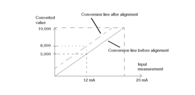
The alignment value is editable from a programming console, even if the program is in RUN mode. For each input channel, you can:
view and modify the desired measurement value
save the alignment value
determine whether the channel already has an alignment
The alignment offset may also be modified through programming.
Channel alignment is performed on the channel in standard operating mode, without any effect on the channel operating modes.
The maximum offset between measured value and desired (aligned) value may not exceed +/-1,500.